
Many businesses start with the simple question, "What do I need to do to have a website?" But in reality, the details are far more extensive. This includes a homepage that clearly communicates the brand, a backend system that the team can manage, SEO considerations starting from the website structure, and even post-launch maintenance to prevent failures. This article summarizes the overall picture for businesses involved. Website creation A comprehensive online guide: What to consider before starting to ensure your website is more than just an online brochure, but a truly functional business tool.
list of contents
- What is a full-service online website development service?
- What types of websites do businesses commonly create?
- Make your website SEO-friendly from day one.
- Systems, functions, and code to consider before starting.
- What needs to be taken care of after a website goes online?
- How to choose a web development team to avoid wasting time on revisions.
What is a full-service online website development service?
The term "full-service" doesn't mean doing everything as much as possible, but rather that the web development team understands the entire process from pre-launch to post-launch. This starts with defining website goals, choosing page structure, designing UX/UI, writing initial content, setting up backend systems, integrating measurement tools, and preparing the site for future growth.
A service company's website might need to focus on trustworthiness and contact forms. An e-commerce website should pay attention to stock, shopping carts, checkout, and product reviews. Large enterprise websites will have additional aspects such as user rights, security, and data management. If the design and systems work start from the actual needs of the business, they will be aligned from the beginning.
What you should get from a comprehensive service.
- A web structure that helps customers quickly understand the service without having to guess.
- The design should have a consistent brand identity throughout the website, rather than individual product pages.
- A backend system that allows website owners to update content themselves.
- SEO fundamentals, speed, security, and measurement—things not forgotten after project submission.
What types of websites do businesses commonly create?
Different types of websites serve different purposes. Choosing the wrong one from the start often leads to rework later. Consider your business's core goals first and determine what the website should help you achieve first.
Company and service brand websites.
This is ideal for businesses that want to build credibility, explain their services, showcase their work, and provide a way for customers to contact them. The homepage should clearly answer the questions: Who do you help? What problems do you solve? And why should customers continue talking to you?
Online shopping website
If a business wants to sell its products directly and doesn't want to rely solely on marketplaces, this type of website should have a complete system for product listings, shopping carts, payments, coupons, shipping, and email status updates from the outset, especially for businesses that need such a system. E-Commerce That can be leveraged for advertising and customer data collection in the long term.
Specialized website or internal system.
Some businesses don't just need a front-end website; they may also need a booking system, membership system, pricing system, course system, or API integration with CRM/ERP. For these types of projects, it's important to discuss the team's actual workflow before discussing the website's appearance, because good UX starts with the functionality that people use every day.
A few short questions before choosing a website type.
Should this website encourage readers to contact you, purchase products, subscribe, or return for repeat business? Answering this will change the entire page structure, budget, timeframe, and the technology that should be used.
Make your website SEO-friendly from day one.
SEO shouldn't be addressed late, when the website is nearing completion. Many aspects of the website's structure, such as page categories, URLs, H2-H3 headings, website speed, internal links, and content that genuinely answers customer questions, need to be considered later. Thinking about it now might require rework entire pages, menus, and sometimes even the entire website structure.
Each webpage should have a clear purpose.
The "Website Services" page should focus on the services offered and shouldn't mix prices, entire portfolios, and all articles on a single page, making it difficult for readers to focus. If there are many topics, they should be separated into subpages or supporting articles with logical links back to the main page.
Content creators must answer questions before selling.
Most customers don't search for "buy a website now" initially. They usually start with questions like, "How much does a website cost?", "Is WordPress or Shopify better?", "What does an e-commerce website need?", or "Why is my website loading slowly?". Having articles that answer these questions helps brands reach customers before competitors and makes communication easier for sales teams.
Small details that often lead to better SEO.
- Name the page and create a meta description that matches the search term.
- Use headings in a logical sequence, don't jump around.
- Insert an alt image description that describes the actual image.
- Internal links to related service pages or articles.
- Make your website load quickly on mobile devices, because most customers don't want to wait for a slow website.
Systems, functions, and code to consider before starting.
A good website isn't just about having a pretty front-end. The back-end must be easy to edit, avoiding bottlenecks for the marketing team every time they want to change text, and the system structure shouldn't hinder business growth when there are more products, articles, or campaigns.
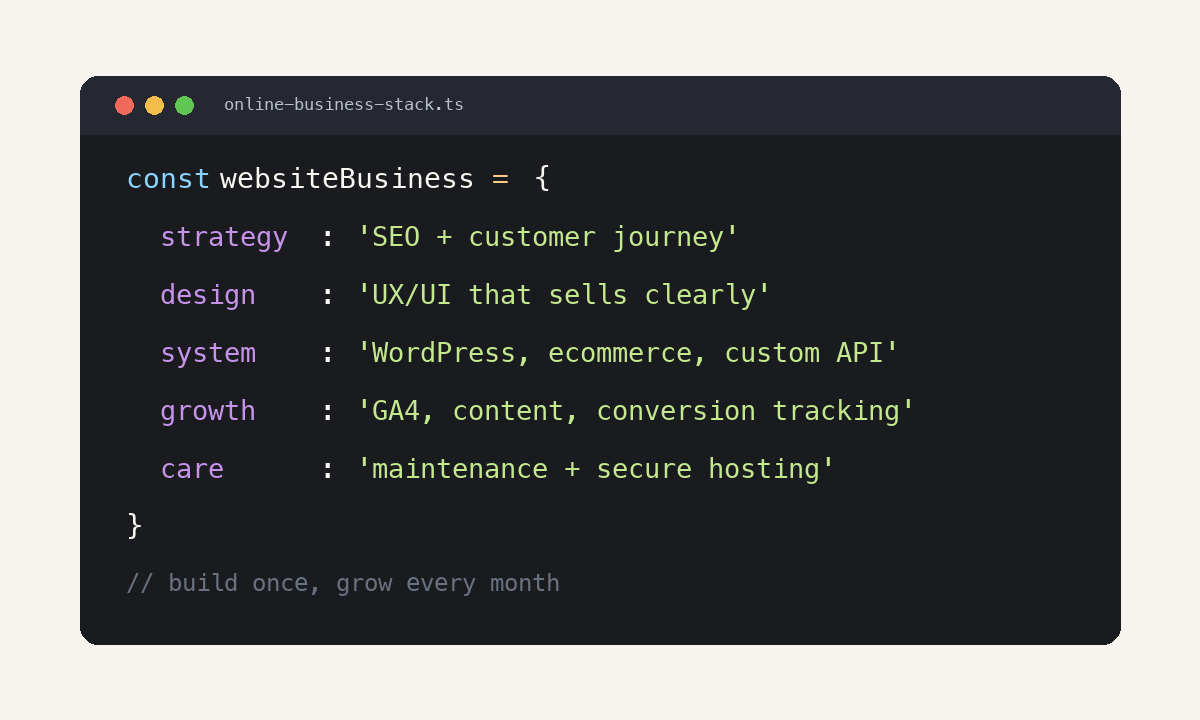
Not all websites require complete customization.
Many projects can utilize WordPress or WooCommerce, which are sufficient and easier to maintain. However, some businesses with specific requirements, such as integrating multiple warehouses, calculating prices based on membership, or having multi-stage approval workflows, may need custom development. It's crucial to clearly distinguish between what should use off-the-shelf systems and what truly requires custom development.
Examples of functions that should be planned in advance.
- A contact form sent via email can generate leads.
- Product and payment systems that support promotions.
- Installing GA4, conversion tracking, and ad pixel.
- Article and landing page management system for campaigns.
- Multi-level user permissions for internal teams.
Note for business owners.
If you're unsure which functions to prioritize, start with those that generate revenue, reduce work time, or help collect customer data immediately. Features that "might be good" but aren't yet in use can be saved for the next phase.
What needs to be taken care of after a website goes online?
Going online isn't the end of the project, but the start of actual data collection. The website needs people to manage system updates, data backups, form testing, speed testing, security fixes, and updating content to reflect new business services, especially for websites using WordPress or e-commerce platforms, which involve plugins and transactions.
Having Website maintenance services Back-end support helps reduce the risk of website downtime, hacking, form failures, or broken pages after updates with no one taking responsibility. Business owners can then focus their time on sales and customers instead of dealing with technical problems one by one.
Numbers you should check every month.
At a minimum, you should look at the number of visitors to your website, the source of traffic, pages with high visitor counts, keywords that are starting to rank higher, the number of leads, sales, and conversion rate. These numbers will tell you where the website needs adjustment, instead of guessing based solely on feelings.
How to choose a web development team to avoid wasting time on revisions.
A suitable web development team for a business doesn't necessarily have to be the one that uses the most technical jargon. Instead, they should be able to ask business questions, understand your customers, and clearly explain the rationale for each option. For example, why this page structure was chosen? Why this function should be implemented first? Why should certain aspects be postponed to phase two?
Checklist before starting a work meeting.
- Do you have a clear web objective, such as increasing leads, boosting sales, or building trust?
- Examples of websites I like and dislike are included, along with the reasons.
- Prepare your brand's core services, products, images, and messaging in advance.
- I know who's in charge of the content after the website is completed.
- There is a realistic budget and timeline that we can discuss.
To summarize in a straightforward manner.
A good online website should be visually appealing enough to build trust, user-friendly enough to retain users, systematic enough for the team to continue working, and measurable enough to let the business know what needs to be improved. Starting with these requirements, a website won't just be an expense, but a digital asset that helps the business gradually become stronger.
Start setting up the website systematically from today.
If you're looking for a team that can help with everything from website structure, design, e-commerce, SEO, to post-launch support and creative work, helping transform your business ideas into a functional website that can be grown and developed in the long term...