
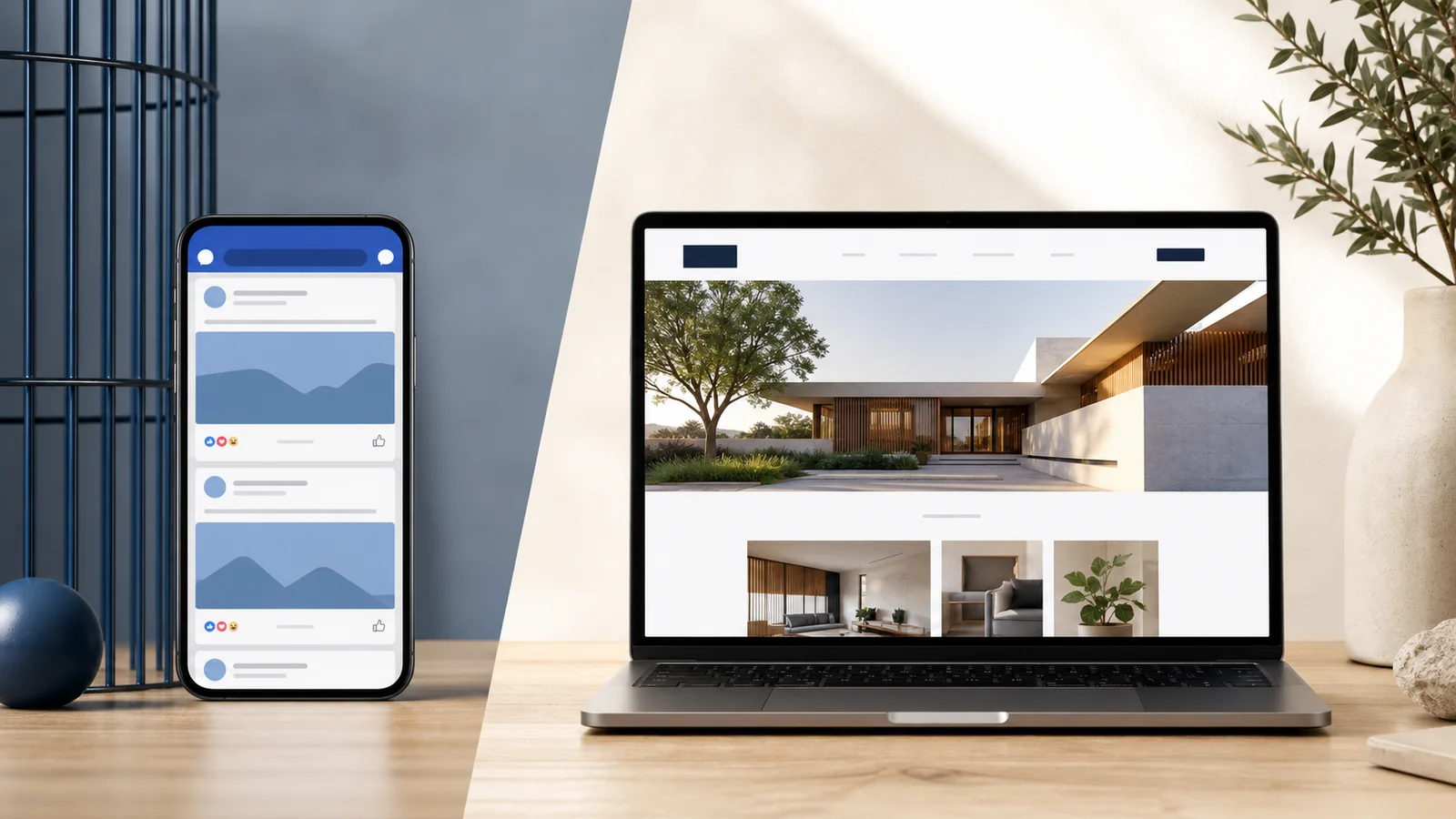
A Facebook Page is also a good way to start a business because it's easy to create, post content immediately, and communicate with customers conveniently. However, "getting started" doesn't necessarily mean "enough for the long term," especially when your sales, reputation, and customer list all depend on a platform you don't own.
A website is not meant to replace Facebook, but rather to serve as the brand's primary home. It's a space where customers can easily access information, view portfolios, compare services, and make decisions without having to scroll through months-old posts. This article will explore the risks of relying solely on one social media platform and how to use a website in conjunction with Facebook to maximize the effectiveness of each channel.
Why a Facebook Page alone is no longer enough for businesses in this era.
Imagine your Facebook Page as a storefront in a shopping mall. You get a lot of foot traffic, have promotional tools, and can open your store quickly. However, the mall dictates opening hours, rules, advertising costs, and where customers will see your store. Your website, on the other hand, is like your headquarters with its own domain name. You're the one who places your signage, categorizes your products, and designs the customer pathways.
Social media is a rented space; websites are digital assets.
Pages, followers, and posts may appear to belong to a business, but all access rights are subject to the platform's rules. If the algorithm changes, visibility decreases, or the account is compromised, businesses have virtually no immediate recourse. Websites using a branded domain mitigate this risk because content, structure, and contact information can be migrated or upgraded.
It's not a choice between Facebook or a website.
The best answer for most businesses is to use both. Facebook is great for creating conversations and introducing new people to your brand, while a website is better for explaining details, building confidence, and keeping important content easily searchable.
Short questions to ask yourself.
If one day customers can't access your page, can they still search for your business name, find the correct information, and contact you through other channels? If the answer isn't clear, a website is the component you should add to strengthen your marketing system.
How do websites help businesses have their own "home"?
Owning a website doesn't just mean having a single webpage; it means having a central hub linked to your business's domain name, and being able to develop it according to your goals without waiting for the platform to add features.
Build credibility with your brand domain.
Company website name and email address help customers easily remember the brand, especially before making payments, requesting quotes, or sending important information.
Organize information according to how customers make decisions.
The About Us page, including services, portfolio, reviews, FAQs, and contact information, can be arranged to answer questions step-by-step.
Collect search results.
Helpful articles and service pages give businesses the opportunity to reach customers who are looking for answers, without having to start visibility from scratch every time they post.
The website transforms visitor traffic into measurable contact paths.
Businesses can designate each page to invite customers to perform the appropriate action, such as requesting a quote, scheduling an appointment, downloading a company profile, or adding products to a cart. Measure which pages generate actual contacts. This data helps optimize advertising budgets and content more accurately than simply relying on likes alone.
Data collection comes with responsibility.
Websites should have a privacy policy, obtain appropriate consent, and collect only necessary data in accordance with the PDPA. Having first-party data doesn't mean using it however one pleases, but it enables businesses to manage customer relationships more transparently and systematically.
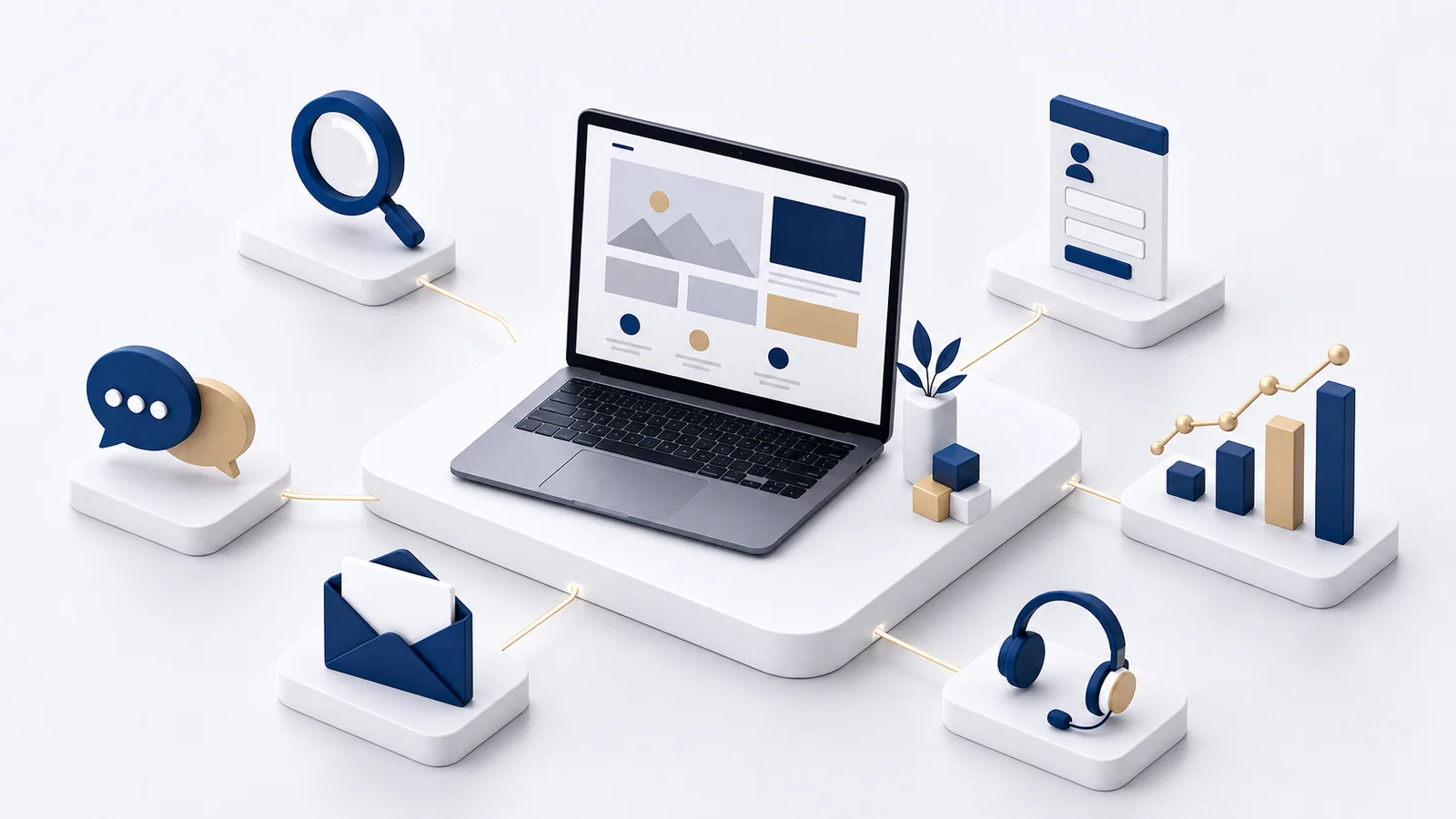
Why are professional website development services different from simply having a website?
A beautiful website that customers can't find information on, loads slowly, or is difficult to use on mobile devices can create more problems than opportunities. Professional work therefore starts with a business goal, not just with choosing colors or a template.
Structure the project based on the customer's questions.
The website development team should help segment users, create a sitemap, and define what information customers need to see before contacting or purchasing a product. A good structure reduces repetitive questions in chats and allows the team to provide a single-page link that fully explains the topic.
Design UX/UI that is optimized for mobile devices and decision-making.
Buttons must be easily visible, content must be easy to read in sequence, forms shouldn't ask too many unnecessary questions, and images shouldn't slow down the webpage. These may seem like small details, but they directly affect the number of people who continue reading and click to contact you.
Laying the foundation for speed, security, and SEO.
The website should have SSL, a backup system, software updates, correct heading structure, meta title/description, and a measurement system from the start. (Provider) We offer complete online website development services. We look at the entire process, from pre-design to post-launch support, not just delivering a website and being done with it.
What a business should receive after delivery.
- Website administrator account and essential user guide.
- Rights to domains, hosting, and assets are explicitly agreed upon.
- Responsive website, checked on mobile and desktop.
- Data backup system, security, and scope of after-delivery care.
- Measurement tools to track visitor numbers and contacts.
Before deciding to hire, you should ask for clarification.
Who owns the domain? Can I edit the content? What are the annual costs? How long is the post-delivery support provided? And what type of data backup is included? I need a system that is easy to manage. WordPress website development service. This is another suitable option for company websites, service websites, and websites that need to update articles regularly.
How can small businesses start building a website on a manageable scale?
There's no need to start with a large website or complex system. The important thing is to begin with the functions customers actually need, and then prepare a structure that can scale in the future.
- Set one main goal. For example, you might need a price quote, want to schedule an appointment, or want to sell products online.
- Starting from the main page, which has 5 pages. These include Homepage, About Us, Services or Products, Portfolio or Reviews, and Contact Us.
- Prepare frequently asked questions from customers. For example, approximate price, work process, duration, service area, and terms and conditions.
- Use a domain that is your brand name. And allows businesses to retain ownership of the domain accounts.
- Define the measurement method before launching the website. For example, the number of forms, the number of call clicks, or the number of orders, can help determine whether the website is truly helping the business.
Let Facebook bring people in, and let the website help them make their decision.
Facebook Pages haven't lost their importance, but businesses shouldn't have to rely solely on one platform. With a website as a central hub, businesses can communicate more comprehensively, measure results more clearly, and reduce the risk of depending entirely on other platforms.
If you're planning to build a new website or revamp an existing one, the Creative Plus One team is ready to assist you with everything from content structuring and UX/UI design to website development and laying the foundation for SEO, all tailored to your specific business goals.





5 Risks When Businesses Rely on Social Media as the Only Channel
1. Visual perception depends on the algorithm.
The number of followers doesn't guarantee that everyone will see your posts. When platforms adjust feed formats or prioritize new types of content, reach may decrease even if you haven't changed your approach. Ultimately, businesses may need to increase their advertising budget to reach the same audience.
2. When an account is restricted, the business immediately comes to a standstill.
Accounts may be locked due to unusual logins, hacking, changes to admin privileges, or malfunctioning verification systems. While these issues can be resolved later, periods of inaccessibility to the page could mean missed chats, paused campaigns, and customers not knowing where to contact them.
3. Customer history and conversations are scattered.
Information in the Inbox is suitable for quick conversations, but not ideal for categorizing leads, tracking quotes, or analyzing which content customers came from. Without a connected form, measurement system, or CRM, marketing often relies more on the team's memory than on factual data.
4. Good posts have a short lifespan and are difficult to find again.
Even well-written posts might get quickly pushed down by newer content, but articles on a website can be categorized, linked, and updated regularly. With proper SEO structuring, existing content has the potential to consistently drive traffic from Google to your business.
5. The page design has limited scope for explaining the brand's differentiation.
All the pages have a similar look. Customers making high-value decisions, such as hiring B2B services, buying real estate, or choosing a clinic, often want more information than just pictures and captions. The website provides a systematic space to explain concepts, showcase work, reviews, workflows, and service terms and conditions.